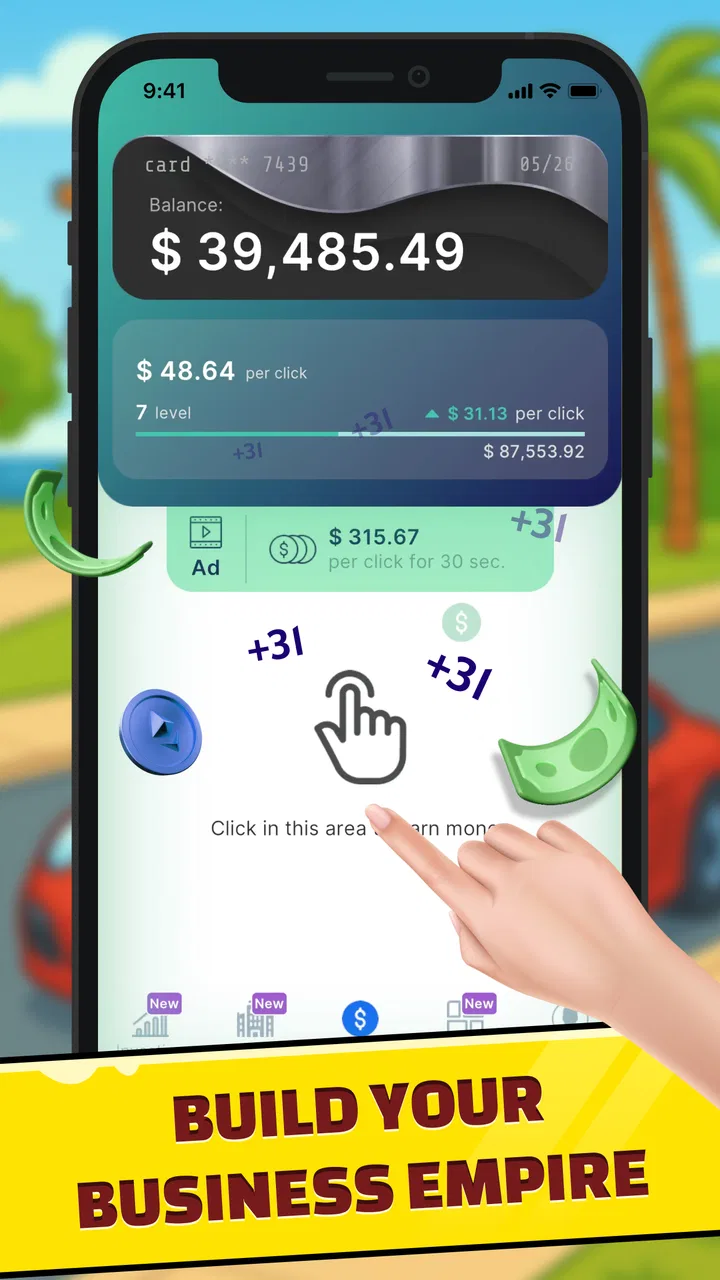
Business Empire: RichMan
- 3.8
- Rating
- 10.00M
- Installs
- Free
- Price

 Analysis by App-foxy
I approached Business Empire: RichMan as a game for people who enjoy turning small decisions into a growing virtual company. It is a free simulation from AAA Fun, built around the idea of managing profitable business deals rather than simply tapping through a short arcade challenge. After spending time with it, I found that its appeal comes from the steady rhythm of checking progress, deciding where to put resources, and waiting for earlier choices to create room for bigger ones.
The first thing to understand is that this is not a quick puzzle game with a clear finish line. It is closer to a pocket tycoon experience: you build momentum over repeated sessions, watch your business position develop, and make choices that matter more as the scale increases. That makes it a natural fit for short visits during the day, but it also means the game asks for patience. If you want constant action or a story that pushes you from one scene to the next, this may feel slower than expected.
How the current version feels to play
The current release is version 1.25.11, and that matters because a long-running management game is judged less by its opening screen than by how comfortably it supports continued play. My impression is that the experience is designed for gradual progress. You are encouraged to return, review the state of your virtual business, and decide which opportunity deserves attention next.
You May Also Like

 Blood Strike: 2.5 Anniversary
Blood Strike’s Loadouts Turn Every Drop Into a Tactical Gamble
A close look at Blood Strike’s custom loadouts: how fast access to signature weapons reshapes its battle royale rhythm, rewards preparation, and narrows the gap between fights.

 Pandora - Music & Podcasts
Pandora’s Music Is Easy to Start, but Harder to Recover
Pandora’s strength is its low-effort path from a seed to a station. Its weak spot is how much confidence it asks you to place in connection, setup, and quiet recovery.

 8 Ball Pool
 Is Built on Rivalries, Rematches, and Routine
A close look at the rivalries, rematches, shared routines, and unanswered safety questions that turn a quick pool match into a persistent mobile community.

 Samsung Music
’s Quiet Strength Is Playing What You Already Own
Its reach comes less from spectacle than from dependable access to a personal library. That simplicity is both the app’s strongest retention engine and its ceiling.

 AccuWeather: Weather Radar
AccuWeather Review: A Quick, Clear Forecast for Everyday Decisions
For everyday plans, the best forecast is the one you can understand quickly. AccuWeather makes rain timing, radar, and local conditions easy to act on, with a few trade-offs.

 Hill Climb Racing
Why Hill Climb Racing Still Turns Crashes Into One More Run
A tiny car, a bumpy hill and one more upgrade: Hill Climb Racing keeps resurfacing because its simple chaos makes every near-miss feel personal.
More From Our News Desk



That structure gives the game a pleasant sense of routine. I could play for a few minutes, close it, and come back later without needing to remember a complicated action sequence. The trade-off is that the most satisfying results are rarely immediate. The game works best when you treat each session as one step in a longer plan instead of expecting every launch to deliver a dramatic reward.
Its presentation also supports that management-first identity. The central pleasure is not reflexes, exploration, or combat. It is the feeling of moving from modest decisions toward more ambitious business activity. That focus keeps the concept easy to understand, although players who prefer detailed tycoon software may eventually want more control than a mobile format usually provides.
The game is listed as suitable for Everyone, which matches its broad, non-violent business theme. I would still describe the experience as more appealing to patient players than to very young children, because understanding the value of delayed progress and repeated investment is part of the fun. The age label tells you the content is accessible; it does not guarantee that the management loop will suit every attention span.
The right way to approach the business loop
My most useful early lesson was to avoid treating every available opportunity as equally urgent. In a tycoon game, it is tempting to spread progress across several directions simply because each one looks attractive. That can leave you with a business that feels busy but does not build strong momentum anywhere. I had better results when I chose a clear priority, observed how it affected future decisions, and only then expanded my attention.
This is also where the game becomes more interesting than its simple premise suggests. The question is not only whether a deal looks profitable. You also have to consider what it does to your next few decisions. A choice that produces a quick improvement may be less useful than one that makes later growth easier. That delayed trade-off is one of the stronger reasons to keep playing after the novelty of the opening has faded.
A practical routine is to begin each session by checking what has changed since your last visit, then decide on one main objective before spending anything. I found this reduces impulsive choices and makes the game feel more like management than random collection. It is particularly helpful when you are playing in short bursts, because you can finish a session with a clear next step rather than simply stopping after a few taps.
What the release history tells existing players
The game was released on December 28, 2021, and its current version shows that it has continued beyond its original launch state. That does not automatically tell me that every system has been transformed, but it does suggest that the developer has kept the product in active circulation rather than leaving it as a one-time experiment.
For someone installing it today, the practical benefit is that you are joining an established mobile game rather than opening an untouched first release. The experience has had time to settle into its current form, and the present version is the one that should guide your expectations. I would not install it expecting a completely different game from the one described by its core business premise, but I would expect the current build to be the intended way to play it.
That distinction is important for returning users. A player who enjoyed the early version may notice that the game now feels more like a maintained long-term product, while a newcomer can start without carrying assumptions from older builds. I prefer judging it by the current loop: does managing the business remain enjoyable, and does each return visit give me a meaningful decision? For me, the answer is generally yes, provided I accept its measured pace.
The broad audience around it is also worth noting. The game has an average rating of 4.0 from around 162 thousand ratings, with roughly 10 thousand written reviews and over 10 million installs. Those figures indicate substantial interest, but they should not be mistaken for proof that the game suits everyone. Management games often divide players between people who enjoy waiting for growth and people who see that same waiting as friction.
How it fits into an everyday routine
A realistic use case is a player who has a few spare minutes before work, during a commute, or while taking a break. In that situation, the game can work well because it does not demand a long uninterrupted sitting. I might open it, review the state of the business, make one deliberate adjustment, and leave with a clearer idea of what I want to do next time.
That same routine can become a weakness if you prefer to play only once a week. A business simulator is easier to enjoy when its decisions remain part of your mental background. Long gaps can make the progression feel less personal, especially if you forget why you chose one direction over another. I would recommend keeping a simple personal rule, such as deciding on a priority before closing the game, so the next session begins with purpose.
Another useful habit is separating progress decisions from entertainment decisions. Sometimes I opened the game simply to see how things were going, while at other times I played with a specific goal in mind. Recognizing the difference helped me avoid spending resources just because I wanted immediate activity. That may sound small, but it is exactly the kind of self-control that makes a virtual business game feel rewarding instead of repetitive.
Where it differs from familiar alternatives
Compared with idle games, this title feels more focused on the idea of business choice than on passive accumulation alone. Idle alternatives are often at their best when you want to watch numbers rise with minimal involvement. Here, the appeal is stronger when you want to feel responsible for the direction of growth, even if the mobile format keeps the systems approachable.
Compared with large PC tycoon games, however, the experience is naturally less demanding. You should not expect the same depth of logistics, staffing, production chains, or financial modeling that a dedicated desktop simulation can provide. The advantage is convenience: this game is easier to pick up and does not require the same commitment. The disadvantage is that experienced management fans may eventually notice that their decisions are simplified.
It also differs from competitive strategy games because the satisfaction is more personal than confrontational. You are not primarily measuring yourself through fast reactions or direct battles. That makes it a calmer option for someone who likes planning, but a weaker choice for anyone seeking multiplayer tension or constant pressure from opponents.
Free access and the spending question
The game is free to download, with in-app purchases ranging from $0.99 to $9.99 per item. That makes it easy to try before deciding whether the business loop deserves a place on your phone. I recommend treating the free experience as the real test: play long enough to see whether you enjoy making gradual decisions, rather than assuming purchases will solve every slow moment.
The presence of optional spending changes how carefully I approach progression. When a game lets you buy items, it becomes even more important to decide what kind of player you want to be before opening the purchase screen. If your enjoyment depends on constant acceleration, the free structure may become frustrating. If you are comfortable with a slower pace, you can judge each purchase as a convenience rather than a requirement.
My advice is to avoid buying simply because a session feels quiet. In a business simulator, quiet periods are often part of the design rhythm. Spend only when you understand what the purchase changes for your play style and why that change is worth it to you. This is a more reliable approach than chasing short-term progress, especially in a game intended to be played over time.
Small decisions that improve the experience
One non-obvious strength is how well the game rewards a planned return cycle. Instead of treating each visit as a separate event, I found it more useful to create a loop: inspect the business, choose a priority, make the adjustment, and leave with a note in mind about what to evaluate later. This turns brief sessions into a connected strategy and prevents the game from becoming a sequence of unplanned taps.
A second insight is that growth should be judged by flexibility, not only by immediate profit. When two choices appear similar, I look at which one leaves more options open for the following session. That approach is especially useful for players who dislike restarting a plan after every small mistake. It also gives the game more depth than simply selecting the option with the largest visible reward.
A third tip is to use the game as a relaxed decision-making exercise rather than a test of speed. I deliberately slow down when several opportunities appear at once, because the cost of a rushed choice is not always obvious immediately. This is where the title can feel surprisingly thoughtful: the most valuable skill is often resisting the urge to act before understanding the direction of your business.
There is also a useful trade-off between variety and focus. Exploring different areas can keep the experience fresh, but concentrating on one clear path makes it easier to understand cause and effect. I would experiment after establishing a stable routine, not before. New players often get more enjoyment from learning one part of the business loop properly than from touching everything at once.
Who should play it, and who should skip it
I would recommend this game to anyone who likes simulation titles that can be checked in short sessions and enjoyed over a longer period. It is a good match for players who find satisfaction in gradual improvement, delayed rewards, and choices that shape the next step. It also suits people who want a business theme without committing to a complex desktop management program.
I would be more cautious recommending it to players who need constant interaction. If you want every minute to contain action, the waiting and repeated checking may feel thin. The same applies if you dislike free-to-play economies on principle. Even when you do not spend, the existence of purchasable items can affect how you perceive the pace.
It is also not the best choice for someone looking for a realistic business education. The game can encourage useful habits such as prioritizing, comparing trade-offs, and thinking ahead, but it remains entertainment. Its simplified decisions should not be confused with a complete model of running an actual company.
What still feels limited
The biggest limitation is the tension between simplicity and depth. The accessible design helps new players understand the objective quickly, but experienced simulation fans may want more layers before long. A game about business can become much richer when decisions have clearly different consequences, and the mobile-friendly structure may not always provide enough complexity for players who want to analyze every variable.
The second limitation is the possibility of routine fatigue. Once you understand your preferred way to approach progress, some sessions can feel more like maintenance than discovery. That is not a flaw for everyone; many players enjoy a dependable daily loop. For me, it means the game is strongest when I set a personal objective instead of opening it without a plan.
The third issue is that the free-to-play format requires discipline. Even a well-designed management game can feel less satisfying if progress appears to be competing with purchase prompts or acceleration options. I would encourage cautious players to decide in advance whether they will spend, then stick to that boundary. The game is easier to evaluate when your opinion is based on its decisions rather than on pressure to speed them up.
What I would watch in future updates
Because the current build is 1.25.11, I would watch for changes that deepen decision-making without making the game harder to understand. New layers would be most valuable if they created meaningful differences between business choices rather than simply adding more tasks. The best improvement would preserve the quick-session convenience while giving long-term players fresh reasons to reconsider their strategy.
I would also pay attention to how the balance between free progress and optional purchases develops. A healthy structure should let patient players feel that their decisions matter, while purchases remain conveniences for people who actively want them. If future changes maintain that balance, the game can continue serving both casual players and more committed tycoon fans.
For existing users, the most important question is whether returning still feels purposeful. New content is useful, but it should support the central business fantasy rather than distract from it. I would rather see a smaller number of thoughtful additions than a crowded interface filled with systems that do not change how I plan.
My recommendation after playing
Business Empire: RichMan is a solid choice when you want a free business simulation that fits around everyday life. AAA Fun has built an experience with a clear identity: make decisions, build momentum, and return to see how your virtual enterprise develops. Its current version gives newcomers an established entry point, while its long-running presence explains why it has attracted a large audience.
I would install it if I wanted a calm tycoon game for short, repeat visits and did not mind gradual progress. I would skip it in favor of a deeper desktop simulator if I needed detailed economic systems, or choose a faster strategy game if I wanted immediate pressure. For everyone else, the best approach is to start without spending, establish a focused routine, and decide whether the satisfaction of building slowly is enough to keep you coming back.
My final verdict: this is an approachable mobile management game with a useful balance of planning and convenience, though its slower rhythm and free-to-play structure will not suit every player. I enjoyed it most when I treated each session as a small business review rather than a race. If that sounds like the kind of progress you enjoy, it is worth trying.
FAQs for Business Empire: RichMan
01What is the main objective of Business Empire: RichMan?
Business Empire: RichMan is a strategic simulation game where players aim to build and expand their business empire. The main objective is to start from a small business, make strategic decisions, and grow it into a global powerhouse, competing with other players and overcoming various economic challenges.
02Is Business Empire: RichMan free to play?
Yes, Business Empire: RichMan is free to download and play. However, it offers in-app purchases that can enhance gameplay by providing additional resources, faster progress, and exclusive features. Players can enjoy the game without spending money, but these purchases can offer a more enriched experience.
03What platforms is Business Empire: RichMan available on?
Business Empire: RichMan is available on both Android and iOS platforms. It can be downloaded from the Google Play Store for Android devices and the Apple App Store for iOS devices, ensuring a broad range of smartphone and tablet compatibility.
04Does Business Empire: RichMan require an internet connection?
While players can enjoy some features of Business Empire: RichMan offline, an internet connection is required for accessing multiplayer modes, updates, and certain in-game events. Being online also ensures that players can compete against others globally and sync their progress across devices.
05How does the game handle player data and privacy?
Business Empire: RichMan takes player privacy seriously. It collects minimal personal information necessary for gameplay and adheres to strict privacy policies. Players have control over their data, and the game complies with standard data protection regulations to ensure a secure gaming environment.
Pros
- Engaging gameplay with strategic depth.
- Variety of business ventures to explore.
- Visually appealing graphics and design.
- Smooth performance on most devices.
- Regular updates with new features.
Cons
- In-app purchases can be pricey.
- Some features require a constant internet.
- Occasional bugs affecting gameplay.
- Tutorials could be more comprehensive.
- Limited customization options.

Business Empire: RichMan
Gallery